

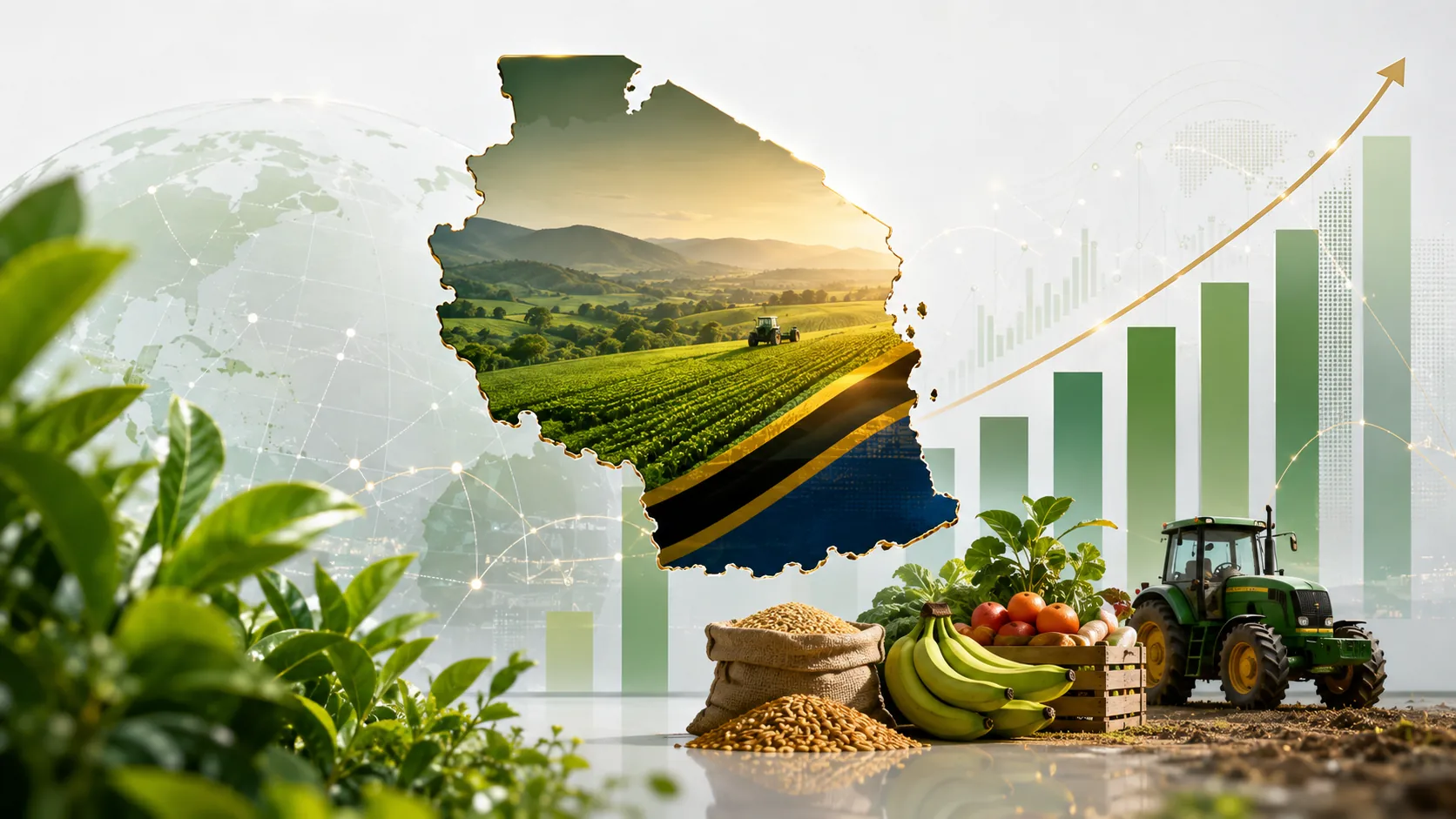
TANZANIA AGRICULTURE: HOW THE SECTOR COULD TRANSFORM THE ECONOMY BY 2050
Tanzania’s agricultural sector is central to economic transformation. Dira 2050 targets higher productivity, value addition, technology, climate resilience, finance and stronger markets to position Tanzania as a leading regional food hub by 2050.
For decades, agriculture has been a foundation of the Tanzanian economy. Under Tanzania Development Vision 2050 (Dira 2050), however, the ambition is to move beyond agriculture as primarily a source of raw commodities and develop it into a highly productive, competitive and sustainable industry capable of positioning Tanzania as a leading regional food hub.
This transformation matters because agriculture is connected to almost every part of the economy—from food production and employment to manufacturing, transport, trade, finance and exports.
According to Dira 2050, the broader agriculture sector, encompassing crops, livestock, fisheries and forestry, contributes 26.5% of GDP, employs 65% of the workforce and generates 30% of export earnings.
The opportunity for Tanzania, therefore, is not simply to produce more.
It is to produce more efficiently, add more value, reach more markets and create more businesses and jobs around agricultural production.
Agriculture at the Centre of Tanzania’s Economic Transformation
Dira 2050 identifies agriculture as one of the country's potential transformative sectors.
The sectors selected under the Vision are assessed according to their potential to generate employment, exports, sector linkages, value addition and government revenue. Agriculture strongly aligns with all five dimensions.
Its importance extends well beyond farms.
Agriculture connects:
Farmers → Processors → Manufacturers → Transporters → Traders → Retailers → Exporters → Consumers
This makes agriculture one of the most important platforms for broad-based economic participation.
A stronger agricultural economy can create opportunities for farmers, agribusinesses, SMEs, financial institutions, logistics companies, technology providers and manufacturers.
The Big Shift: From Agriculture to Agribusiness
One of the most important ideas in Tanzania’s agricultural transformation is the shift from viewing agriculture primarily as production to viewing it as a complete agribusiness value chain.
The opportunity begins with production but does not end there.
A successful agricultural value chain can include:
Inputs → Production → Collection → Storage → Processing → Packaging → Transport → Marketing → Export
Each stage creates economic activity.
This is where value addition becomes critical.
Instead of exporting or selling agricultural commodities in relatively raw forms, Tanzania can increasingly develop products that are processed, packaged, branded and prepared for domestic, regional and global markets.
Dira 2050 specifically highlights agriculture's strong linkages with manufacturing, transport and trade and its potential to generate income through value-added products.
Crops: Moving Toward High-Value Production
The crops subsector is expected to play an important role in Tanzania's future food and export economy.
Dira 2050 calls for greater emphasis on high-value, market-oriented produce.
This means production decisions increasingly need to respond to:
- Market demand
- Consumer preferences
- Processing opportunities
- Export markets
- Climate conditions
- Productivity
- Profitability
The long-term opportunity is to strengthen the connection between farmers and markets so that production is increasingly guided by commercial opportunity rather than production alone.
Progress.tz opportunity
From Farm to Market: Can Tanzania Build More Profitable Agricultural Value Chains?
Livestock: Modernising Production and Market Value
Livestock is another major component of Tanzania's agricultural economy.
Dira 2050 envisions the subsector being modernised through investment in efficient production systems that increase productivity and market value.
That transformation can extend across:
- Animal production
- Feed systems
- Veterinary services
- Meat processing
- Dairy production
- Leather
- Cold-chain logistics
- Marketing
The opportunity is therefore to move toward more efficient and commercially integrated livestock value chains.
Progress.tz opportunity
Tanzania’s Livestock Economy: Where Is the Next Wave of Value Addition?
Fisheries and Aquaculture: Expanding the Blue Food Economy
Fisheries form part of the broader agricultural sector covered by Dira 2050.
The Vision calls for stronger development of sustainable fishing, aquaculture and cold-chain logistics.
This is significant because fisheries can connect food production with:
- Processing
- Storage
- Transport
- Hospitality
- Retail
- Exports
- Marine tourism
Aquaculture also provides an opportunity to expand fish production while creating new businesses around production, feed, equipment, processing and distribution.
Progress.tz opportunity
Aquaculture Tanzania: Can Fish Farming Become a Larger Source of Food, Jobs and Investment?
Forestry: Conservation and Commercial Opportunity
Forestry is also included within Dira 2050's definition of the agriculture sector.
The Vision calls for stronger strategies for:
- Forest conservation
- Sustainable use of forest resources
- Commercial forestry
- Forest-based enterprises
The challenge is to balance economic utilisation with environmental sustainability.
The opportunity is to develop a forestry economy in which sustainable resource management supports businesses, employment and value addition while protecting Tanzania's natural assets.
Technology Could Change Tanzanian Agriculture
Agriculture's future will increasingly depend on technology.
Dira 2050 calls for significant investment in modern technology and highlights science and technology as one of the catalytic drivers of national transformation.
Technology can support agricultural transformation through:
- Digital market information
- Farm management
- Weather information
- Productivity monitoring
- Digital payments
- Supply-chain management
- Agricultural data
- Precision farming
- Mechanisation
- Online market access
Dira 2050 specifically envisions the digitalisation of agricultural processes to connect producers with real-time market opportunities.
The long-term direction is therefore clear:
From traditional production systems → to data-informed and digitally connected agriculture.
Climate-Resilient Agriculture Is Becoming Essential
Agriculture's transformation cannot be separated from climate resilience.
Dira 2050 identifies climate change as a significant threat to food security and agricultural productivity, noting rising temperatures and changing rainfall patterns among the challenges affecting Tanzania.
The Vision therefore emphasises:
- Climate-smart agriculture
- Climate-resilient infrastructure
- Sustainable farming practices
- Efficient resource use
- Environmental protection
- Resilience to climate-related shocks
This is not simply an environmental issue.
It is an economic issue.
A climate-resilient agricultural sector protects food production, farmer incomes, supply chains, exports and national economic stability.
Irrigation and Infrastructure: Building Reliable Production
Agricultural productivity depends heavily on infrastructure.
Dira 2050 highlights the need for climate-resilient infrastructure alongside investment in modern technology and affordable energy.
Infrastructure can help address some of the structural challenges facing agricultural production and markets.
Key areas include:
- Irrigation
- Rural roads
- Storage facilities
- Warehousing
- Cold chains
- Electricity
- Water systems
- Market infrastructure
- Transport networks
Better infrastructure can reduce post-harvest losses, improve market access and make agricultural production more commercially viable.
Affordable Energy Can Unlock Agricultural Processing
Energy is another critical part of the agricultural value chain.
Farmers and agribusinesses require energy not only for production but also for:
Irrigation → Processing → Refrigeration → Storage → Packaging → Distribution
Dira 2050 identifies energy as one of five catalytic drivers of transformation and emphasises reliable, affordable and sustainable energy as essential for productivity and economic development.
For agriculture, reliable energy can help move more businesses from selling raw products toward processing and value addition.
Access to Finance: The Capital Behind Agricultural Growth
Agricultural transformation requires investment.
Farmers and agribusinesses need capital to acquire:
- Machinery
- Irrigation systems
- Seeds and inputs
- Livestock
- Storage facilities
- Processing equipment
- Transport
- Digital technologies
Dira 2050 specifically identifies access to finance as an important requirement for agricultural transformation.
Expanding appropriate financing can therefore help farmers move from subsistence-oriented production toward commercial agribusinesses capable of scaling operations.
Markets Will Determine the Next Stage of Growth
Producing more is only valuable when producers can reach profitable markets.
Dira 2050 calls for the expansion of market networks and digital systems that connect producers to real-time market opportunities.
For Tanzania, the market opportunity extends beyond domestic consumers.
Agricultural businesses can potentially serve:
Tanzania → East Africa → SADC → Africa → Global Markets
This creates an opportunity to build agricultural products that meet international requirements for quality, consistency, packaging, traceability and reliability.
Agriculture and Manufacturing: A Powerful Economic Connection
One of the most important opportunities is the relationship between agriculture and industry.
Agriculture can supply raw materials to:
- Food processors
- Beverage manufacturers
- Textile companies
- Leather industries
- Packaging businesses
- Feed manufacturers
- Consumer-goods companies
Manufacturing can, in turn, supply agriculture with:
- Machinery
- Tools
- Packaging
- Irrigation equipment
- Storage systems
- Processing technology
This creates a two-way economic relationship.
Agriculture feeds industry.
Industry modernises agriculture.
Dira 2050 explicitly identifies the strong linkages between agriculture and manufacturing as part of the sector's potential to drive broad-based economic growth.
SMEs Can Become the Missing Link
Agricultural transformation will not be driven only by large companies.
Small and medium enterprises can operate across the value chain.
For example:
Farmers → Local collection SME → Processing SME → Packaging company → Transport SME → Retailer → Exporter
This creates opportunities for thousands of businesses to participate in agricultural growth.
Potential SME opportunities include:
- Agro-dealerships
- Food processing
- Cold storage
- Transport
- Packaging
- Agricultural technology
- Veterinary services
- Equipment maintenance
- Warehousing
- Digital marketplaces
- Export services
The more developed the value chain becomes, the greater the potential for agriculture to generate businesses beyond the farm.
Agriculture and Employment
Agriculture's importance to employment makes its transformation particularly significant.
Dira 2050 states that the broader agriculture sector employs 65% of Tanzania's workforce.
This means improvements in agricultural productivity and profitability can have broad effects on household incomes and livelihoods.
But the future employment opportunity should not be limited to farming.
A modern agricultural economy can create jobs in:
Agronomy + Engineering + Processing + Logistics + Finance + ICT + Marketing + Research + Manufacturing + Export
That is how agriculture can become an increasingly sophisticated source of employment.
Agriculture and Food Security
Food security is another central dimension of agricultural transformation.
A more productive and resilient agricultural sector can strengthen Tanzania's capacity to:
- Produce sufficient food
- Manage climate risks
- Reduce supply disruptions
- Improve storage
- Strengthen domestic markets
- Develop strategic food value chains
The long-term objective is therefore not simply to become a major agricultural producer, but to become a competitive and resilient regional food hub.
That is the direction explicitly set out in Dira 2050.
Tanzania as a Regional Food Hub
The concept of Tanzania becoming a leading regional food hub by 2050 is one of the most important agricultural ambitions in the Vision.
Achieving this will require more than increasing farm output.
It will require an integrated system of:
Production
Storage
Processing
Transport
Markets
Finance
Technology
Energy
Export infrastructure
This is where agriculture intersects with Dira 2050's other transformation drivers, particularly integrated logistics, science and technology, energy, research and development and digital transformation.
Where the Investment Opportunities Are
The agricultural transformation creates opportunities across the entire value chain.
Production
Modern farming, livestock systems, aquaculture and commercial forestry.
Agro-processing
Food, beverages, animal products and other value-added products.
Irrigation
Water infrastructure and efficient irrigation systems.
Storage
Warehouses, silos, cold rooms and logistics.
Agricultural Technology
Digital platforms, data, precision agriculture and farm-management tools.
Logistics
Transport, cold chains and distribution networks.
Finance
Agricultural lending, insurance and innovative financing.
Energy
Reliable and affordable energy for farms and processing facilities.
Export
Packaging, certification, market access and international distribution.
The Challenges Tanzania Must Address
The agricultural opportunity is significant, but the transformation will require sustained investment and reform.
Key areas identified by Dira 2050 include:
- Modern technology
- Climate-resilient infrastructure
- Innovative programmes for farmers
- Affordable energy
- Access to finance
- Expanded market networks
- Digitalisation
- Environmentally sustainable farming practices
The objective is to create a sector that is simultaneously productive, competitive, sustainable, inclusive and globally connected.
What Tanzania’s Agricultural Transformation Should Look Like
The long-term transition can be understood through several shifts:
| From | Toward |
|---|---|
| Raw commodities | Value-added products |
| Subsistence production | Commercial agribusiness |
| Limited market information | Digital market intelligence |
| Traditional systems | Modern technology |
| Climate vulnerability | Climate resilience |
| Local markets only | Regional and global markets |
| Farm-level activity | Integrated value chains |
| Limited processing | Agro-industrialisation |
| Informal transactions | More structured commercial systems |
| Production alone | Production + processing + trade |
Progress.tz Agriculture Agenda
For Progress.tz, agriculture should become more than a news category.
It can become a permanent editorial and data series tracking:
AGRICULTURE TODAY
What is happening across Tanzania's agricultural sector?
FARM TO FACTORY
Who is adding value to Tanzanian agricultural products?
AGRIBUSINESS OPPORTUNITY
Where are the emerging business opportunities?
FOOD HUB TANZANIA
How is Tanzania progressing toward regional food-hub status?
AGRICULTURE & TECHNOLOGY
How are digital tools changing production and markets?
AGRICULTURE & INVESTMENT
Where are investors putting capital?
FARMER TO MARKET
What is happening to market access, logistics and prices?
CLIMATE-SMART TANZANIA
How are farmers adapting to climate change?
This approach would allow Progress.tz to report not only what happened, but also what changed, who benefited and where the next opportunity lies.
PROGRESS.TZ TAKE
Tanzania's agricultural sector is much more than a traditional economic activity.
It is a national transformation platform.
With 26.5% of GDP, 65% of the workforce and 30% of export earnings attributed to the broader agriculture sector in Dira 2050's baseline, the sector has enormous influence over Tanzania's economic future.
The opportunity is to move:
From farming to agribusiness.
From raw materials to value addition.
From local markets to regional and global markets.
From traditional production to technology-enabled agriculture.
From climate vulnerability to resilience.
From individual farms to integrated value chains.
By 2050, Dira 2050 envisions agriculture as a highly productive, competitive and sustainable industry capable of positioning Tanzania as a leading regional food hub.
The real measure of progress will be whether that transformation produces higher farmer incomes, more jobs, stronger businesses, greater food security, increased exports and more value captured within Tanzania.
Progress.tz will track that transformation—farm by farm, value chain by value chain, investment by investment and result by result.
SEO FAQ
What is the importance of agriculture to Tanzania’s economy?
According to Dira 2050, the broader agriculture sector—including crops, livestock, fisheries and forestry—contributes 26.5% of GDP, employs 65% of the workforce and generates 30% of export earnings.
What does Dira 2050 say about Tanzania’s agricultural sector?
Dira 2050 envisions agriculture becoming a highly productive, competitive and sustainable industry, with Tanzania positioned as a leading regional food hub by 2050.
What are the main agricultural subsectors in Tanzania?
The agricultural sector under Dira 2050 encompasses crops, livestock, fisheries and forestry.
What are Tanzania’s agricultural investment opportunities?
Opportunities span modern production, agro-processing, irrigation, storage, cold-chain logistics, agricultural technology, livestock, aquaculture, forestry, finance, energy and export-oriented value chains.
Why is value addition important to Tanzania’s agriculture?
Value addition can increase the economic value of agricultural products, strengthen links with manufacturing and trade, create jobs and improve Tanzania’s competitiveness in domestic and international markets. Dira 2050 specifically identifies value-added agricultural products as an important source of job creation and income.
How can technology transform agriculture in Tanzania?
Dira 2050 calls for modern technology and the digitalisation of agricultural processes to connect producers with real-time market opportunities, while science and technology are identified as a catalytic driver of national transformation.
How will climate change affect Tanzania’s agriculture?
Dira 2050 identifies rising temperatures and changing rainfall patterns as threats to agricultural productivity and food security and calls for climate-resilient infrastructure and climate-smart approaches.
What is Tanzania’s agricultural ambition for 2050?
The long-term ambition is to develop a productive, competitive and sustainable agricultural industry that positions Tanzania as a leading regional food hub.
Source basis: Tanzania Development Vision 2050, particularly the sections on transformative sectors, agriculture and the Vision's catalytic drivers.