

Tanzania and development partners map out climate funding measures
Tanzania has outlined a three-pillar strategy to address a $12bn climate finance shortfall, focusing on stronger institutions, investment-ready projects and measures to attract capital.
Tanzania, working with international financial institutions and development partners, has announced measures to close a climate financing gap of approximately US$12 billion towards the US$19.3 billion required to implement its second Nationally Determined Contribution (NDC 2.0) by 2030.
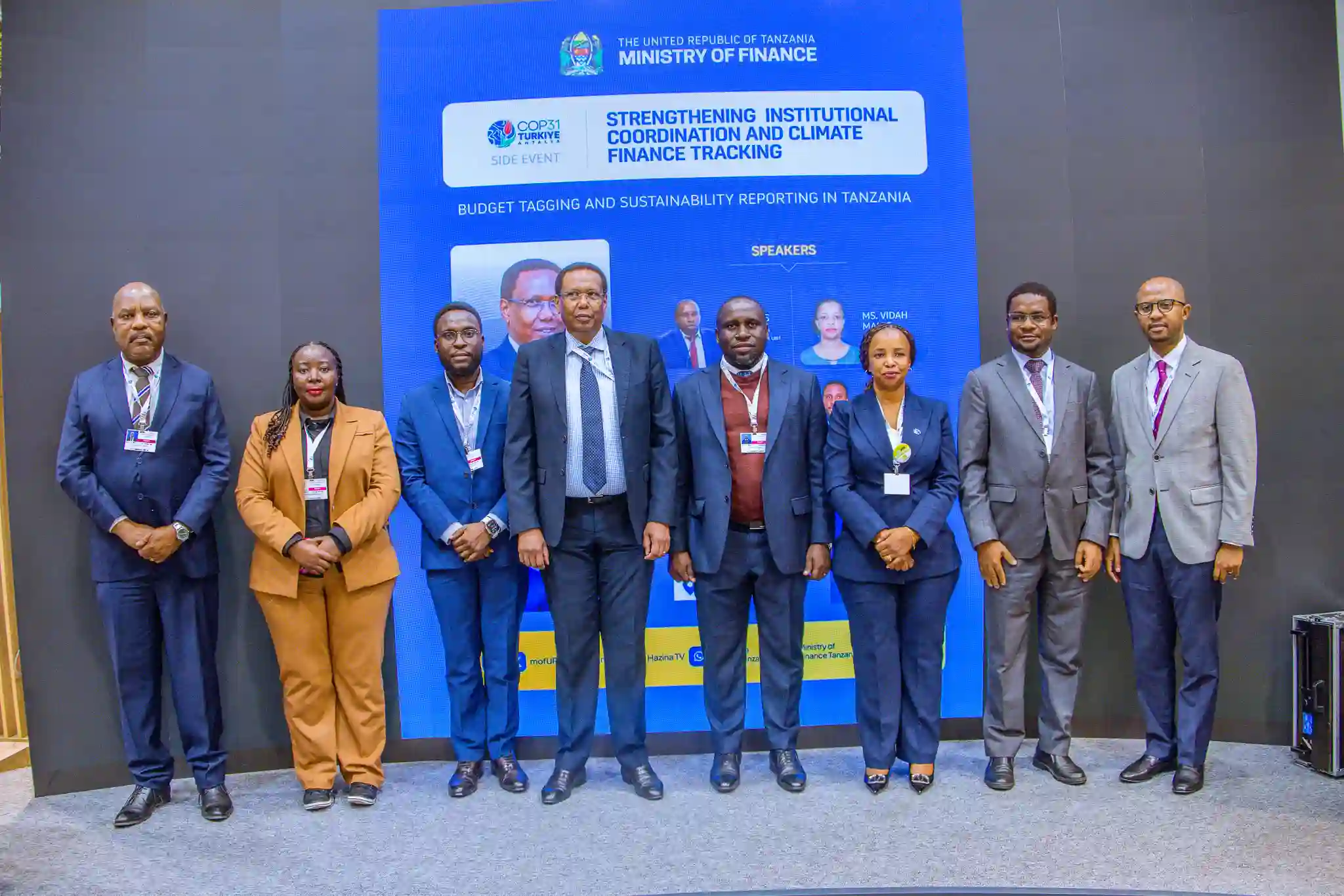
The measures were outlined by the Ministry of Finance’s Commissioner for External Finance, Mr. Rished Bade, on behalf of Minister for Finance, Hon. Ambassador Khamis Mussa Omar, during a Finance and Trade Day side event at the Tanzania Pavilion at the 31st United Nations Climate Change Conference (COP31) in Antalya, Türkiye.
Bade said the measures followed resolutions adopted at the 2026 Tanzania Climate Finance Roundtable, held in Dar es Salaam on October 5, 2026.
Tanzania has so far mobilised US$7.3 billion, equivalent to approximately TZS 19.3 trillion, leaving a further US$12 billion, or about TZS 31.8 trillion, to be secured. The measures will strengthen the climate finance framework, prepare priority projects for investment and mobilise public and private capital.
He said the initiative aligns with Tanzania Development Vision 2050, Zanzibar Development Vision 2050, the Fourth Five-Year Development Plan (2026/27–2030/31), the National Adaptation Plan (2025–2035) and the Paris Agreement.
It also builds on reforms supported by the International Monetary Fund’s Resilience and Sustainability Facility, the World Bank-supported Scaling-Up Locally Led Climate Action programme and the United Nations Capital Development Fund’s Local Climate Adaptive Living Facility (LoCAL).
Bade outlined three pillars underpinning the Government’s approach.
The first involves developing a National Climate Finance Strategy and strengthening the institutions responsible for mobilising, coordinating, managing and tracking climate finance.
“This approach will address institutional capacity, climate finance planning, climate budget tagging, expenditure tracking, sustainable finance frameworks and monitoring through existing systems within the Ministry of Finance, the Vice President’s Office, Zanzibar authorities, sector ministries, local government authorities and financial sector institutions,” he said.
The second pillar focuses on preparing investment-ready, bankable projects that reflect national priorities. Priority sectors include climate-resilient agriculture, water security, renewable energy, clean cooking, resilient infrastructure, sustainable natural resource management and the blue economy.
The third seeks to mobilise capital and reduce investment risks through blended finance, credit guarantees, climate insurance, green and other labelled bonds, results-based financing, long-term lending and carbon finance.
“Grants and concessional finance will be used strategically to improve project viability, reduce risks and attract commercial capital. Particular priority will be given to adaptation and resilience investments that deliver substantial public benefits but offer limited commercial returns,” Bade emphasised.
He said the IMF, through AFRITAC East, had committed to providing training on climate budget tagging where needed. The World Bank will strengthen the operational capacity of Climate Finance Units in Mainland Tanzania and Zanzibar through the SCALE project.
The United Nations Development Programme (UNDP) has committed to supporting the first workstream, while the African Development Bank (AfDB) will support the second, particularly a Project Preparation Facility focused on adaptation.
The Global Environment Facility (GEF) has expressed interest in supporting all three pillars, with an emphasis on blended finance under GEF-9.